Should You Be Fibermaxxing? What the Trend Gets Right, and What It Leaves Out
I have been asked this three times in a week, so let's do it properly. Fibre matters, and most of us are eating half of what we should. But fibre is not one thing, your gut is an ecosystem with tenants already living in it, and pouring in a lot of one kind, fast, can feed the wrong ones. Here is what the research actually says, how to increase fibre without wrecking your week, and why I will always tell you to look before you max.
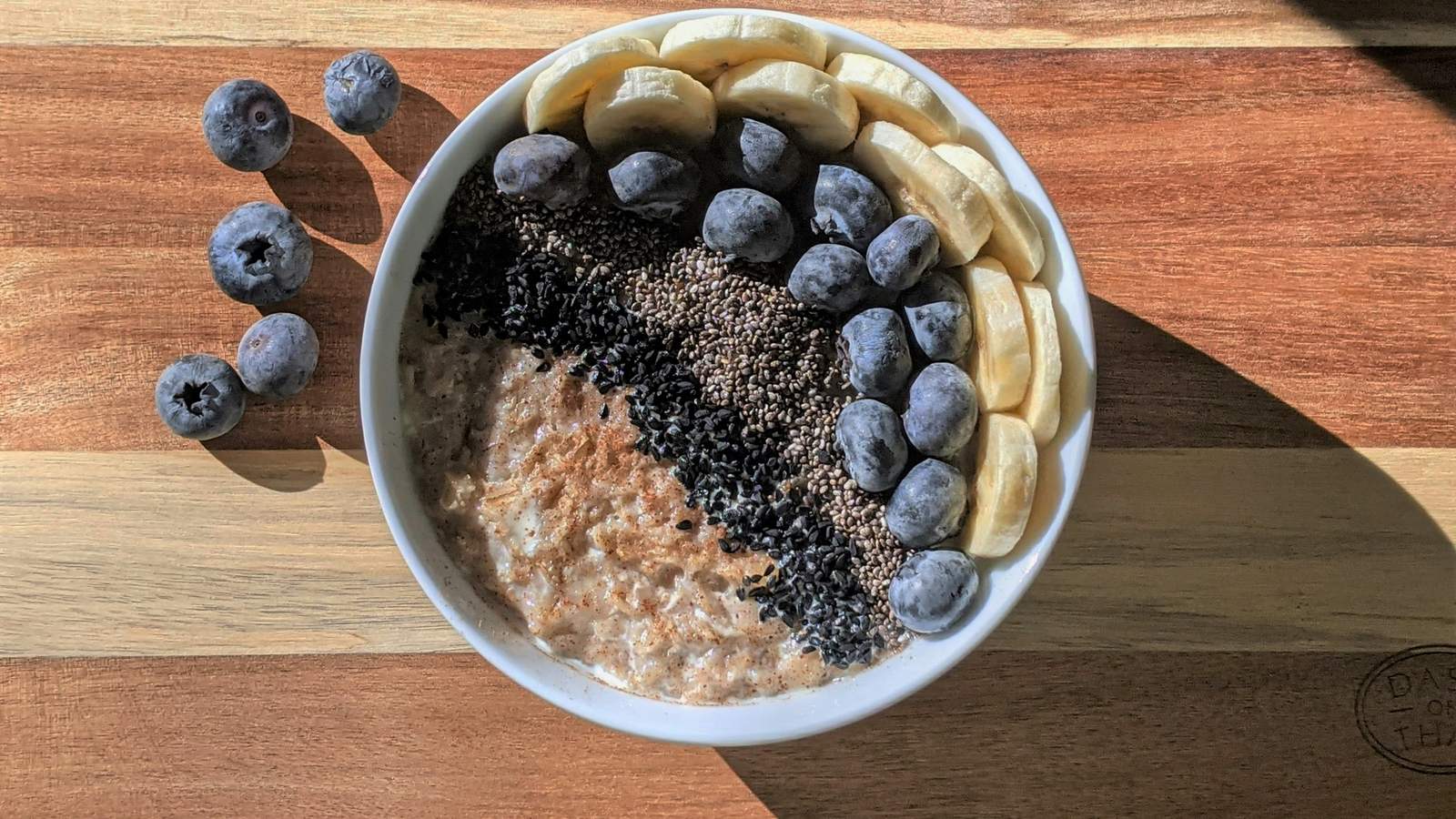
If you have opened TikTok this year, you have seen it: chia in everything, psyllium in the smoothie, a bowl of lentils for breakfast and a running tally at the top of the screen. Fibermaxxing. The idea is simple — eat as much fibre as you possibly can, every day, and your gut, your weight and your energy will sort themselves out.
I want to be fair to it, because the instinct underneath the trend is one of the better ones the internet has produced. And then I want to tell you the part it leaves out, because that part is where people end up in my office feeling worse on a diet that is supposed to be healthier.
What the trend gets right
Almost nobody eats enough fibre. Health Canada estimates that Canadians average somewhere between 14 and 17 grams a day. The guideline is about 25 grams for adult women and 38 for adult men. So the average person is at roughly half of where they should be, and has been for decades.
That gap matters more than most nutrients do. In 2019 a team led by Andrew Reynolds published a series of systematic reviews and meta-analyses in The Lancet pulling together 185 prospective studies and 58 clinical trials — close to 135 million person-years of data. People eating the most fibre had roughly a 15 to 30 percent lower risk of dying from any cause, and of heart disease, stroke, type 2 diabetes and colorectal cancer, compared with people eating the least. The sweet spot for the biggest reductions sat between 25 and 29 grams a day, with hints of more benefit above that.
Why? Partly mechanical — fibre slows how fast sugar hits your blood, keeps you full, and keeps things moving. But the more interesting reason is that fibre is not really food for you. It is food for them. The trillions of bacteria in your large intestine ferment it, and in return they produce short-chain fatty acids — butyrate, propionate, acetate — which feed the cells lining your gut, calm your immune system, and talk to your brain and your metabolism all day long.
So yes: eat more fibre. On that, the trend and I agree completely.
What it leaves out: fibre is not one thing
Here is where fibermaxxing goes wrong. It treats fibre as a single number to push up, like protein grams or steps. It is not. "Fibre" is a category, and the things inside it are chemically different molecules.
The beta-glucan in oats. The inulin in onions, garlic and chicory. The pectin in apples. The resistant starch in cooled potatoes and green bananas. The galacto-oligosaccharides in beans and lentils. Psyllium husk. Cellulose in leafy greens. These have different shapes, different chain lengths, and different bonds holding them together — and different bacteria carry the enzymes to break down different ones.
The clearest demonstration of this was done right here in Edmonton. In 2020, Edward Deehan, Jens Walter and colleagues at the University of Alberta published a controlled human trial in Cell Host & Microbe. They gave participants resistant starches with subtly different chemical structures — same broad category of fibre, slightly different molecule — and tracked what happened in the gut. Each structure shifted the microbiome in its own specific, predictable direction, favouring different bacterial species and producing different short-chain fatty acids: one pushed propionate, another pushed butyrate. Change the fibre, change who gets fed.
Read that again in the context of a trend that tells you to eat as much of any fibre as you can. If you triple your inulin intake, you are not "feeding your gut." You are feeding the specific organisms that eat inulin. Whoever they are.
Your gut is an ecosystem, not an empty bucket
This is the mental model I want you to leave with. Your large intestine is not a bucket you pour good things into. It is a crowded, competitive ecosystem with hundreds of species already living there, in proportions that are unique to you and were shaped by your birth, your childhood, your antibiotics history, your stress, your sleep and every meal you have ever eaten.
When you change the food supply suddenly, you change who wins. In a healthy, diverse gut, that usually works out fine — the beneficial species that eat fibre expand, and everybody benefits. But a lot of adults do not start from a healthy, diverse gut. They start from years of low fibre, a few rounds of antibiotics, high stress and short sleep. In that gut there may already be an overgrowth of something — a species that has been quietly taking more than its share — and it may be perfectly happy to eat the fibre you just added.
The Stanford data on this is worth knowing. In 2021, Hannah Wastyk, Justin and Erica Sonnenburg and colleagues published a randomised trial in Cell: 36 healthy adults, 17 weeks, half assigned to a high-fibre diet and half to a diet high in fermented foods. The high-fibre group more than doubled their fibre intake. Their microbiome diversity did not increase over the ten-week maintenance phase — and their immune responses split into three distinct patterns, depending on how diverse their microbiome was when they started. The fermented-food group, meanwhile, saw diversity steadily rise and inflammatory markers fall.
The lesson is not "fibre bad, sauerkraut good." The lesson is that the same fibre intervention produced different results in different people, and the difference was what was already living there. Fibre added to a gut that has the right residents pays off. Fibre added blindly to a gut you have never looked at is a coin toss.
Why it shows up everywhere except your gut
Here is the frustrating thing about gut imbalance: it rarely feels like a gut problem. Bloating and gas, sure. But the signs that bring people to me are usually somewhere else entirely.
Brain fog. Your gut bacteria produce and regulate compounds that cross into your bloodstream and talk to your nervous system — this is the gut-brain axis, and it is now one of the most studied areas in medicine. When the wrong organisms are producing the wrong compounds, "I just cannot think clearly by two o'clock" is a common way it presents.
Breakouts. The gut-skin axis is real and increasingly well documented. Reviews in the dermatology literature over the last few years link altered gut bacteria to acne, psoriasis and eczema through inflammation and immune signalling. A 2025 case-control study in Dermatology Practical & Conceptual found that people with acne had significantly higher blood levels of TMAO — a compound made by gut bacteria from certain foods — than people with clear skin. Adult acne that does not respond to skincare is very often a gut conversation.
Body odour. Certain gut bacteria produce trimethylamine, the compound responsible for a fishy odour in sweat and breath when the body cannot clear it. Less dramatically, shifts in which bacteria dominate change the volatile compounds your body produces. If your odour has changed and your hygiene has not, that is information.
Add to that list: low energy, poor recovery from training, stubborn body composition despite good habits, irregular digestion, and reflux. None of these is a diagnosis. All of them are a reason to look.
And here is the connection to fibermaxxing. If one of those unwelcome organisms is present, and you start pouring in a large dose of exactly the fibre it likes, you can make every one of those symptoms louder. I have watched it happen. A person eats "cleaner" than they ever have and feels foggier, puffier and more broken-out than before, and concludes that healthy eating does not work for them. It does. They just fed the wrong tenant.
What a fibre-starved gut does, for balance
I do not want you to walk away afraid of fibre, so here is the other side. In 2016, Mahesh Desai and colleagues at the University of Michigan published a study in Cell — in mice, so read it as a mechanism rather than a prescription — showing what happens when a gut is deprived of fibre. The bacteria do not starve quietly. They switch to eating the mucus layer that lines and protects your intestinal wall. That layer thins, and the mice became dramatically more susceptible to a gut pathogen.
That is the fibre-starved gut: bacteria eating the wall. So the answer is absolutely not "avoid fibre." The answer is to feed the ecosystem deliberately — the right fibres, at the right pace, for the gut you actually have.
How to increase fibre without wrecking your week
The safe way up
- Go slow. Add about three to five grams every few days. Your bacteria need time to adjust their numbers to the new food supply. Going from 15 to 40 overnight is how you get a week of bloating and a story about how fibre "does not agree with you."
- Go wide, not deep. Diversity of fibre beats quantity of any one fibre. Oats, beans, lentils, berries, nuts, seeds, cooled potatoes, vegetables of every colour. Thirty different plants a week is a better target than a single big number.
- Whole foods before powders. Psyllium and inulin supplements are a big dose of one fibre type. They have their place, but they are the fastest way to feed one organism a lot. Earn them with food first.
- Drink more water. Fibre without water is how constipation happens. Non-negotiable.
- Listen for a fortnight. Some gas in the first week is normal. Bloating, fog, breakouts or odour that persist past two weeks are not — they are a signal to stop guessing and test.
- Pair it with the walk. Ten minutes after meals helps digestion and blood sugar, and fibre works better on a body that moves.
Why I will always say: test first
I have said this about protein, about training loads, about sleep, and I will say it about fibre. You cannot know what to prioritise for a gut you have never looked at.
The Alberta study told us different fibres feed different bacteria. The Stanford study told us the result depends on who is already there. Put those two findings together and the conclusion is unavoidable: the correct fibre strategy for you is determined by the current state of your microbiome, and the only way to know that state is to measure it.
A microbiome gut test shows you which strains you carry, in what proportions, what is overgrown, what is missing, and what by-products they are producing. From there, "eat more fibre" turns into something specific: this fibre, from these foods, to feed these under-represented species — and this one to hold off on for now, because it feeds something you have too much of. Sometimes it also shows an organism that should not be there at all, in someone who had no idea, and explains two years of symptoms in one page.
That is the whole difference between fibermaxxing and actually fixing your gut. One is a number. The other is a plan.
The honest summary
Eat more fibre. Most of you should. Do it slowly, from a wide range of whole foods, with water, and with your eyes open. If your body pushes back for more than two weeks, that is not failure — that is your ecosystem telling you something, and it is worth listening.
And if you have brain fog, breakouts, odour changes or bloating you have been living with for a while: those are not personality traits. They are signals from a system you can measure. Let's measure it.
Stop guessing. Test your gut.
Our Microbiome Gut Test shows exactly which strains you carry, what is overgrown, what is missing, and which fibres and foods to prioritise — and which to leave alone. We build your nutrition plan around your ecosystem, not TikTok's. Testing is done at our private studio near the Yellowhead corner in Edmonton. Book a consultation with Sanja or Kurtis or reply to this week's Fushion Times.