The Ten-Minute Walk After Dinner: The Simplest Blood Sugar Habit You Own
Of every habit covered in this journal, this is the one I would bet on you actually keeping. It costs ten minutes, it requires no equipment, and the research behind it is unusually consistent. Here is what happens to your blood sugar after you eat, why moving your legs changes it, and why the walk after supper is the one that matters most.
I want to talk about the least impressive habit I know.
It cannot be sold to you. There is no device for it, no supplement stack, no protocol with a name attached. You will not feel it working. Nobody has ever posted about it. And of everything we cover in this journal, it is the one I would bet on you actually keeping — because the barrier to entry is roughly zero.
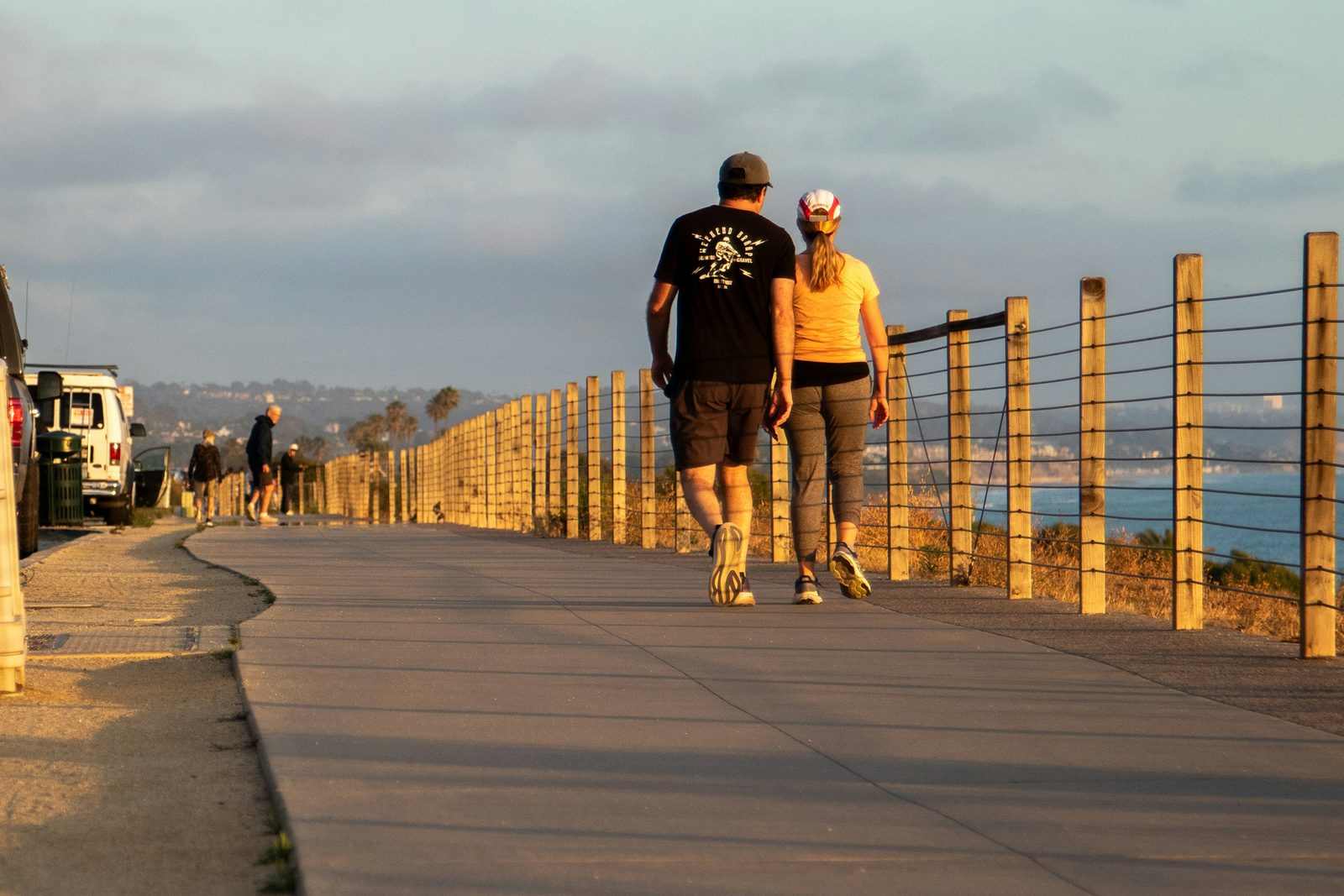
After you eat, go for an easy ten-minute walk.
That is the whole thing. What follows is why it works, what the research actually shows, and the one detail most people get wrong.
What actually happens after you eat
When you finish a meal, carbohydrate is broken down into glucose and moved into your bloodstream. Your blood sugar climbs. Your pancreas releases insulin, which acts like a key, letting glucose out of the blood and into your cells where it can be used or stored.
How high that climb goes, and how long it stays up, is the part worth caring about. A steep spike followed by a sharp fall is what produces the two o'clock slump — the heavy eyes, the sudden interest in a second coffee, the odd hunger an hour after a meal you thought was plenty. A gentler rise and a smoother return is what steady energy actually feels like from the inside.
Now here is the thing almost nobody is told: what you do in the thirty minutes after eating changes that curve significantly. Not marginally. Measurably.
Why moving your legs changes the number
Muscle is the largest glucose sink in your body. When a muscle contracts, it pulls glucose out of the bloodstream to fuel that contraction — and, importantly, contracting muscle can take up glucose through a pathway that does not depend entirely on insulin doing the work first.
This is the whole mechanism, and it is worth sitting with for a second. Sitting still after a meal means glucose clearance is left almost entirely to insulin. Walking means your legs — the biggest muscles you own — start pulling glucose out of the blood directly, at precisely the moment the glucose is arriving.
You are not burning off the meal. Ten minutes of strolling burns a trivial number of calories, and anyone who tells you otherwise is selling something. What you are doing is changing where the glucose goes and how quickly it gets there. Same meal, different curve.
What the research actually found
This is an unusually well-studied habit for something so mundane, and the findings line up better than they do in most areas of nutrition science.
Ten minutes after each meal beat thirty minutes once a day
The cleanest study is a 2016 randomised crossover trial published in Diabetologia (Reynolds and colleagues). Forty-one adults with type 2 diabetes, average age 60, alternated between two two-week blocks: walking 30 minutes once a day, or walking 10 minutes after each of their three main meals. Blood sugar was tracked with continuous glucose monitors.
The same total walking time. Only the timing changed. Post-meal glucose came out roughly 12 percent lower in the after-meals condition.
That result deserves a moment. It is not saying walking is good for you — we knew that. It is saying that when you walk changes what the walking does.
The after-dinner walk did most of the work
Buried in that same trial is the detail that changed how I schedule my own evenings. The 12 percent was an average across all three meals. The individual walk carrying most of the benefit was the one after the evening meal, where glucose over the following three hours was around 22 percent lower — and the effect was largest when that meal was higher in carbohydrate.
Which makes complete sense when you picture a normal day. Supper is usually the biggest carbohydrate load. It is also almost always followed by the longest uninterrupted stretch of sitting anyone does — the couch, the screen, and then bed.
Even two to five minutes registered
A 2022 systematic review and meta-analysis in Sports Medicine (Buffey and colleagues) pooled seven studies looking at breaking up prolonged sitting. The activity breaks were short — two to five minutes of light walking. Light walking breaks reduced post-meal glucose by roughly 17 percent compared with sitting straight through, and, notably, walking outperformed simply standing up.
Standing helped. Walking helped more. This matters because it lowers the bar so far that "I did not have time" stops being true. Two minutes is not a time commitment. It is a decision.
After the meal beats before it
A 2023 systematic review with meta-analysis in Sports Medicine by Engeroff, Groneberg and Wilke — published under my favourite academic title of recent years, "After Dinner Rest a While, After Supper Walk a Mile?" — compared exercising before a meal with exercising after it. Exercising after eating produced a greater reduction in post-meal glucose than exercising beforehand. The analysis also found that the shorter the gap between finishing the meal and starting to move, the bigger the effect.
Sooner is better. Not two hours later. Not "I will go after this episode."
And it is not only relevant if you have diabetes
A 2013 trial in Diabetes Care (DiPietro and colleagues) found that three 15-minute post-meal walks improved 24-hour glucose control in older adults at risk of impaired glucose tolerance. The 2022 meta-analysis above pooled adults broadly, not only those with a diagnosis.
You do not need a condition for this to be worth doing. Smoother glucose curves mean less insulin demand, and over years, that is one of the levers that shows up in nearly every serious longevity protocol. It just does not look impressive enough for anyone to build a business around it.
How to actually do it
The whole protocol
- Ten to fifteen minutes. Two to five still counts on a bad day. Do not let perfect be the enemy of stepping outside.
- Start soon. Within about thirty minutes of finishing, and sooner is better.
- Easy pace. Strolling. You should be able to hold a conversation without effort. This is not a training session and it should not feel like one.
- Prioritise supper if you only manage one, and prioritise it hardest after a carb-heavy meal.
- Anchor it to something that already happens — clearing the table, letting the dog out, taking the bins down, walking to the mailbox the long way.
Practical versions that work for real people: walk to the end of the block and back after supper. Do a lap of the parking lot after lunch. Take the stairs down and back up at work. Stand and do the dishes, then step outside for five minutes before you sit down. Get off one stop early.
Pair it with morning daylight — the ten minutes of light we covered here — and you have covered two of the highest-leverage habits available to you. Both free. Both outside. Both take twenty minutes of your day between them.
What this is not
I want to be straight with you, because the internet is not.
It is not a licence. A ten-minute walk does not cancel a meal. It changes the shape of a glucose curve; it does not undo a consistently poor diet, and it is not a weight-loss intervention.
It is not a replacement for training. This does not build muscle, it does not build cardiovascular fitness, and it does not replace resistance training — which remains the single most important thing you can do for how you age. Post-meal walking is an addition, not a substitution.
It is not a medical protocol. If you take insulin or any medication that can cause low blood sugar, talk to your care team before adding regular post-meal activity. If you have reflux, keep it gentle. And if you are managing a diagnosed condition, your physician's advice outranks anything you read here, including this.
What it is: a small, free, repeatable lever that does something measurable, that you can start tonight, and that compounds quietly over decades. That is a rare combination, and it is the reason this is the one I nag people about.
The honest reason I am writing about this
Most of what we do at the studio is hard. Heavy things get picked up. Intervals hurt. There is no version of getting strong that is comfortable, and I am not going to pretend otherwise.
But the things that actually determine how you feel at seventy are rarely the dramatic ones. They are the boring, repeatable, almost invisible habits that you did ten thousand times without ever thinking of them as training. Ten minutes after supper is exactly that kind of habit.
It will never feel like it is working. That is the point. Do it anyway.
Want the rest of your plan to be this specific?
We build training, nutrition and longevity programming around your actual biology — including microbiome, DNA and skin DNA testing — at our private studio near the Yellowhead corner in Edmonton. If you want to know what your own numbers say rather than what the average says, book a consultation with Sanja or Kurtis.